
Health
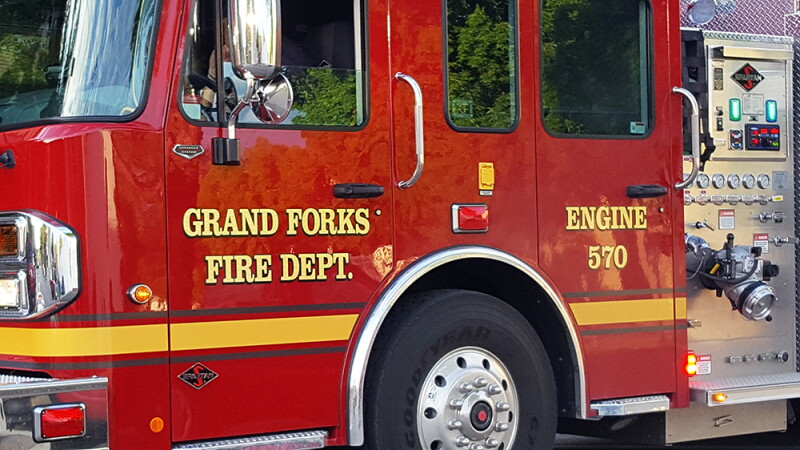
Emerado Volunteer Fire Department extinguishes 2-acre fire
By Amina El-Amin
Advertisement · Why this ad?
Lydia Smallwood is a seasoned journalist with a degree in Business Communication from the University of Minnesota. With six years of writing for local publications and a focus on small businesses, she brings stories of innovation and resilience to the forefront.
More from Lydia →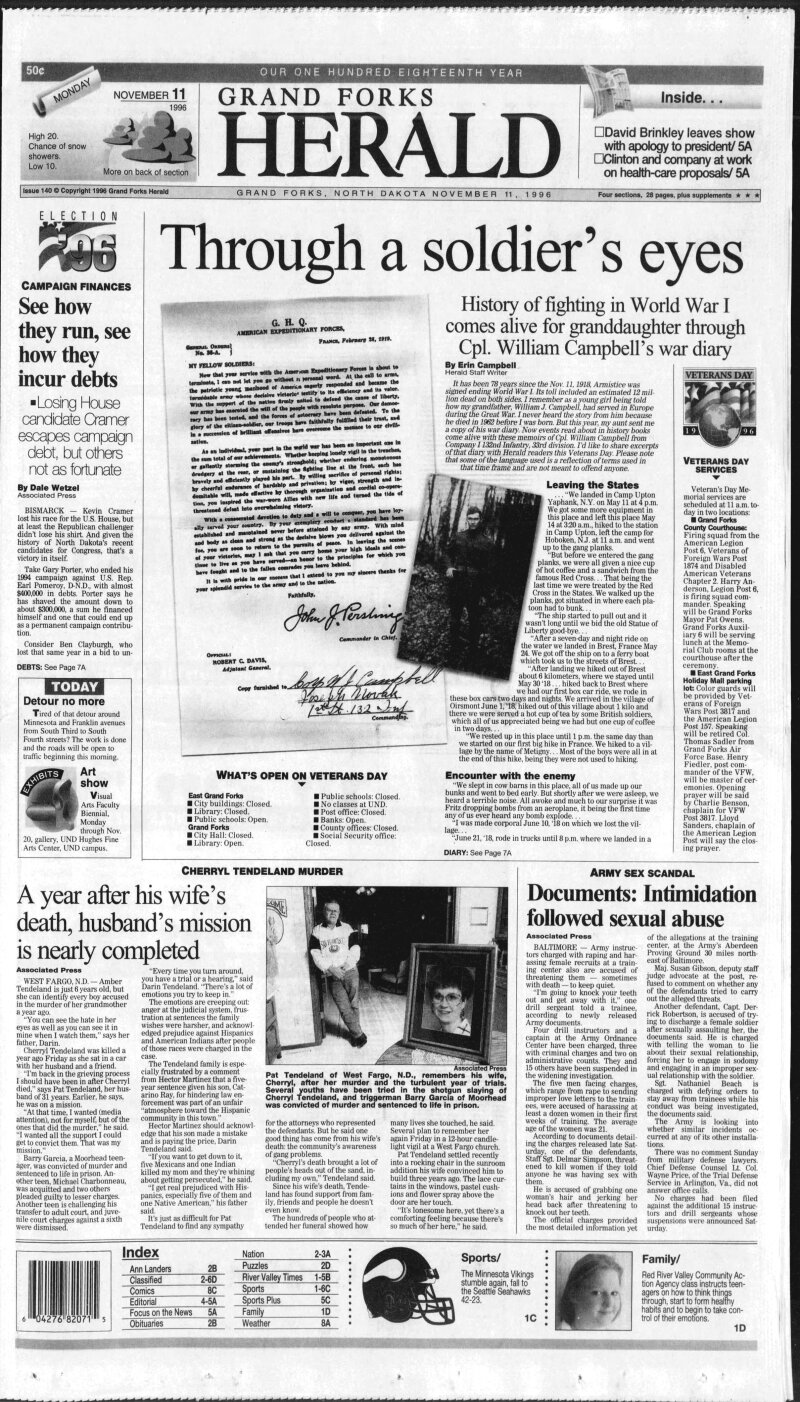
By Staff reports Today at 12:01 AM Listen Comments Share Share this article News Reporting News Reporting Based on facts, either observed and verified firsthand by the reporter, or reported and verified from knowledgeable sources. The Trust Project What is this? Today in History revisits the Monday, Nov. 11, 1996, edition of the Grand Forks Herald and highlights a story of Cpl. William Campbell, who kept a diary of his time in World War I. His granddaughter, Erin, was the Herald reporter who shared his story, giving her a first glimpse of his service history. At the time of this story, it had been 78 years since Armistice was signed, on Nov. 11, 1918, ending World War I. Through a soldier's eyes History of fighting in World War I comes alive for granddaughter through Cpl. William Campbell's war diary By Erin Campbell Herald Staff Writer ADVERTISEMENT It has been 78 years since the Nov. 11, 1918, Armistice was signed ending World War I. Its toll included an estimated 12 million dead on both sides. I remember as a young girl being told how my grandfather, William J. Campbell, had served in Europe during the Great War. I never heard the story from him because he died in 1962 before I was born. But this year, my aunt sent me a copy of his war diary. Now events read about in history books come alive with these memoirs of Cpl. William Campbell from Company I 132nd Infantry, 33rd division. I'd like to share excerpts of that diary with Herald readers this Veterans Day. Please note that some of the language used is a reflection of terms used in that time frame and are not meant to offend anyone. Leaving the States "... We landed in Camp Upton Yaphank, N.Y. on May 11 at 4 p.m. We got some more equipment in this place and left this place May 14 at 3:20 a.m., hiked to the station in Camp Upton, left the camp for Hoboken, N.J. at 11 a.m. and went up to the gang planks. "But before we entered the gang planks, we were all given a nice cup of hot coffee and a sandwich from the famous Red Cross ... That being the last time we were treated by the Red Cross in the States. We walked up the planks, got situated in where each platoon had to bunk ... "The ship started to pull out and it wasn't long until we bid the old Statue of Liberty good-bye ... "After a seven-day and night ride on the water we landed in Brest, France May 24. We got off the ship on to a ferry boat which took us to the streets of Brest ... "After landing we hiked out of Brest about 6 kilometers, where we stayed until May 30 '18 ... hiked back to Brest where we had our first box car ride, we rode in these box cars two days and nights. We arrived in the village of Oirsmont June 1, '18, hiked out of this village about 1 kilo and there we were served a hot cup of tea by some British soldiers, which all of us appreciated being we had but one cup of coffee in two days ... "We rested up in this place until 1 p.m. the same day than we started on our first big hike in France. We hiked to a village by the name of Metigny ... Most of the boys were all in at the end of this hike, being they were not used to hiking. ADVERTISEMENT Encounter with the enemy "We slept in cow barns in this place, all of us made up our bunks and went to bed early. But shortly after we were asleep, we heard a terrible noise. All awoke and much to our surprise it was Fritz dropping bombs from an aeroplane, it being the first time any of us ever heard any bomb explode ... "I was made corporal June 10, '18 on which we lost the village ... "June 21, '18, rode in trucks until 8 p.m. where we landed in a large woods by the name of Mollien au-bois near a village named St. Gration. This was a place Fritz used to come over these woods with his big bombing planes and every now and then he would drop one in these woods. "This was on the Somme front. We went into real battle on July 4, '18. Our regiment with some good work captured 1,800 prisoners on this date. "This was the first time any men from the 33rd saw real fighting. My first time up to the lines in no-man's land, July 10, '18. I went up with the sniper section to learn how to do the duties as a sniper and scout and I sure found out, as we went out on patrols nearly every night. We came back after being there seven days and then the whole regiment went back to the lines on July 22 to take over a sector of our own ... "On July 28 Fritz dropped one of his big shells in the woods in which we camped and it caused much excitement. We went back up to the lines again on July 30. We took over a sector on the Somme front ... "On Aug. 3, '18 three men from our scouts section went out on a daylight patrol ... One of the men had his rifle busted all to pieces when a German sniper opened fire on them, making a direct hit on his rifle. ADVERTISEMENT Meeting other Allies "Mid-August: The Australians had driven the Boche back and many German bodies were still lying on the field. We found many of the Germans' rifles they had left behind and some of their grenades ... At 5:30 p.m. we left this place to go to the front lines to help the Australians. After a long tiresome hike, we hit the front line and the Australian soldiers were very glad to see us come to give them aid as they sure were in a bad position. Harboniers was the name of this place. "The way the Boche shelled this place it was fierce. We did not go ahead of this place but we held the Huns. "Aug. 20 we left this place. We were relieved by some more Australians. We suffered many casualties ... "The night of Aug. 20 we rode in trucks from the Harboniers front to a place called Longeau. There was a fine place to go swimming and all of us made use of it. "We left Longeau Aug. 25 for the American sector. "On Sept. 18 another corporal and myself went out to see if we could find another observation post ... We started out. We hiked to a large hill, the French name of it is Le-Mort Homme , better known as Dead Mans Hill ... As we went to cross this hill at one point the Huns' snipers opened fire on us. "At this we lay down, crept back to a trench, took the long way to get over this hill to keep from shell fire. We hiked in this trench until we hit large tunnels that the Germans had built through this hill so they could use them to make a strong attack on the French in 1917 and '18. ADVERTISEMENT "After looking around we found a ladder leading up to a high stairway. We went up this ladder and went all the way to the top of these stairs. When we reached the top we found a big steel observation post. We had our strong power scope with us and from this place we could see the Germans in the woods just opposite of this hill. We gained much information from this point. Gas attack "On the morning of Sept. 20 we had a gas attack by the Boche. They shot over 268 shells in 48 minutes, most of them were high explosive shells with gas. "Sept. 26: ... We crossed this swamp which was ahead of us. We started forward, through this swamp, shells hitting near by us, but when they hit the mud some of them did not explode. The machine gun bullets passed by us making some great sounds. "Every now and then a comrade would fall by side, being hit by the Boche machine gun bullet. "We would take a few steps and all at once step into a shell hole 5 to 6 feet deep full of water. "Early October: As we entered these woods of Bois-De-Faire, you could see bodies laying nearly everywhere. And as we entered the woods we got gassed and we kept shooting over gas and high explosive shells. Company I went into this place with 206 men strong on Oct. 6 and came out Oct. 13 with 36 men. Many men from Company I got gassed on Oct. 8, '18. The Huns shot over gas for 24 hours ... "As we walk quietly along the shells would burst and knock down large trees and we were gassed on our way out of this patrol. We walked past many of our dying comrades, we could do nothing to help them. ADVERTISEMENT "Many would cry out 'tell mother I will not come ba
By Amina El-Amin

By Clara Jensen
By Lydia Smallwood
By Lydia Smallwood